
Free template
Keep the teacher in control. Start with a clear AI policy.
Artificial intelligence is already in your schools, in the apps students use, the tools teachers try at night, and the features vendors quietly switch on. A clear policy helps you get the benefits while protecting students, staff and trust, and it keeps teachers in control of what happens in the classroom.
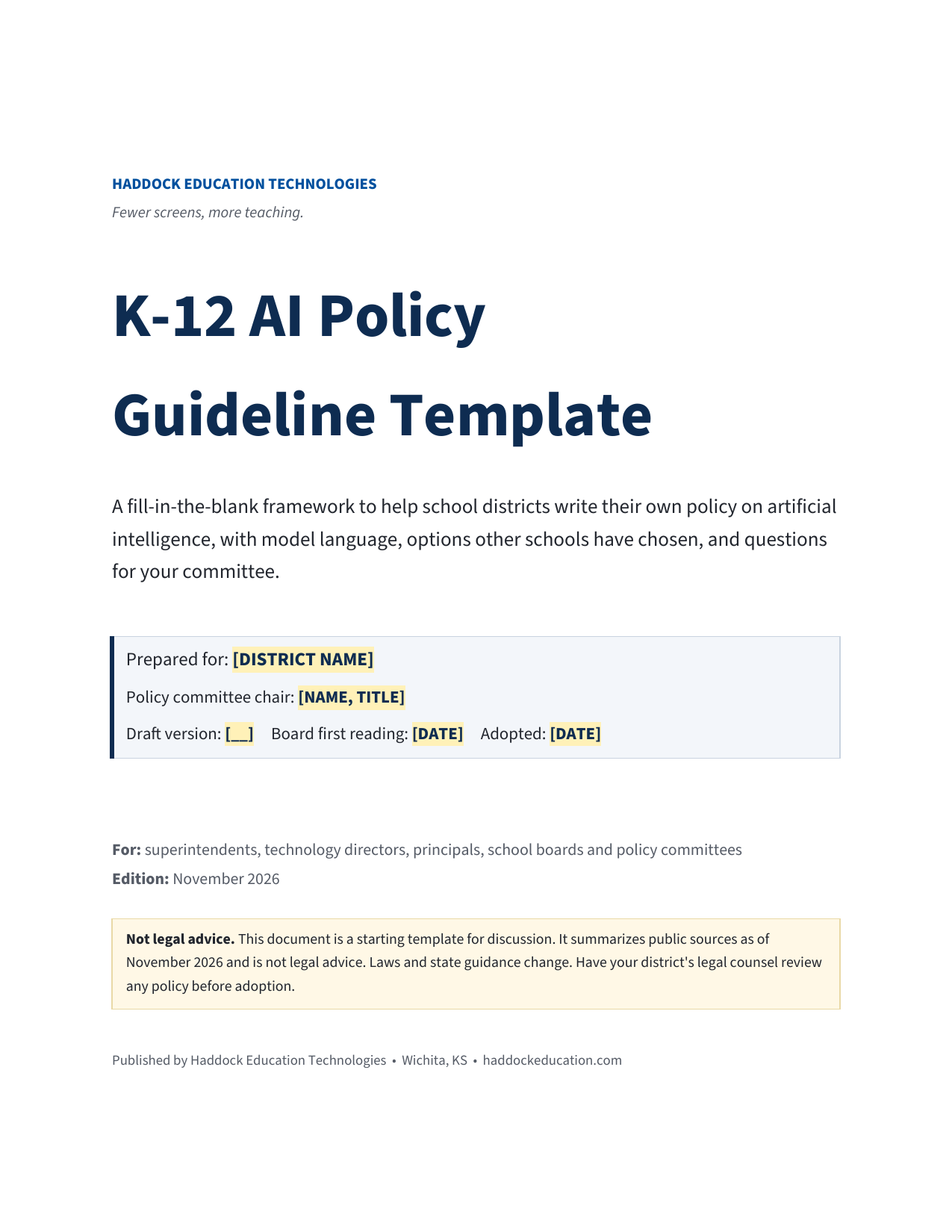
This free fill-in-the-blank template is for superintendents, technology directors, principals, school boards and policy committees. Each of the 18 sections has model language you can adopt, edit or delete, options other schools have chosen, and questions for your committee. Fill in the blanks, delete what does not apply, and have your legal counsel review the draft before it goes to the board.
Districts are writing this now. CoSN’s U.S. State of EdTech 2026 report found that 79% of districts have AI guidelines in place, up from 57% in 2025, but only 38% have created a new policy specifically for AI. A September 2026 review by the Center for Education Market Dynamics (CEMD) of 219 districts across 43 states found that 44% had no formal AI policy adopted or in progress.
Sources: CoSN, U.S. State of EdTech 2026 (the 79% and 38% figures also appear in CoSN’s summary at https://www.cosn.org/edtech-topics/state-of-edtech-leadership/) · CEMD, K–12 AI Policy: How Districts Are Navigating Guidance, Practice, and a Rapidly Changing Landscape (September 28, 2026)
The full template, including a Word file you can edit, is free. Tell us a little about your school or district and you can download it right away.
This guide is for general information only. Review it with your own team, and with legal counsel where appropriate, before implementing anything in your school or district. It is not legal advice.
What’s in the template
The template has 18 sections. You can use them as a stand-alone policy, as updates to existing policies, or both.
- Purpose and Guiding Principles. Why the policy exists and the values that will guide every decision, including keeping humans, and teachers, in the loop.
- Definitions. Clear definitions so everyone knows whether a rule about “AI” applies to spell-check, a reading app, or a chatbot.
- Scope. Who and what the policy covers, including students, staff, contractors, volunteers and third parties.
- Roles and Responsibilities. Who approves tools, trains staff, handles incidents and reports to the board.
- Approved Tools, Vetting and Procurement. A clear path to review tools before they are used, and an approved-tool list.
- Student Data Privacy and Security. How student information is protected, including a simple rule: no student personal information in a tool that does not have a district data agreement.
- Student Use by Grade Band, Age Requirements and Parental Consent. Age-appropriate expectations, each tool’s age limits, and when parent permission is needed.
- Academic Integrity. How teachers tell students, assignment by assignment, what AI help is allowed, using a shared scale.
- Teacher and Staff Use. Helpful staff uses such as lesson planning, differentiation and draft communications, while keeping professional judgment and privacy intact.
- Equity and Accessibility. Making sure AI does not widen gaps, and that students with disabilities get equal access.
- Bias, Accuracy and Human Review. AI can be wrong or biased. A qualified person reviews output before it is used or relied on for a decision.
- AI Literacy and Professional Development. Teaching students how AI works, and training staff on the policy and practical use.
- Assessment and Instruction Design. Designing assignments that make student thinking visible, rather than relying only on policing.
- Parent and Community Communication. Plain-language notice to families about tools, data and how to raise concerns.
- Deepfakes, Harassment and Misuse. Treating AI-generated impersonation, harassment and nonconsensual images as serious misconduct, and connecting that to existing bullying, harassment and Title IX procedures.
- Administrative and Operational Uses. The same vetting, privacy and human-review rules for AI used in operations, scheduling, website chatbots and student-safety monitoring.
- Incident Reporting and Consequences. How to report problems, and how consequences are applied fairly.
- Review Cycle and Policy Governance. A regular review and a way to update procedures between reviews.
The appendices give you tools to put the policy to work:
- A sample AI use level scale for assignments
- An AI tool and vendor vetting checklist
- A sample parent/guardian letter
- Sample classroom syllabus statements
- A one-page implementation timeline
Each section has four parts: a short purpose, model policy language with blanks to fill in, options other schools have chosen, and questions for your committee.
Related: AI in Schools: A Practical Guide for What to Do Monday, by Richard Haddock, with an AI-use ladder, a one-page classroom AI policy and a Monday checklist.
Quick answers
What should a district AI policy cover?
At a minimum, the areas in this template: purpose and guiding principles; definitions; scope; roles and responsibilities; approved tools, vetting and procurement; student data privacy and security; student use by grade band, age requirements and parental consent; academic integrity; teacher and staff use; equity and accessibility; bias, accuracy and human review; AI literacy and professional development; assessment and instruction design; parent and community communication; deepfakes, harassment and misuse; administrative and operational uses; incident reporting and consequences; and a review cycle. The appendices add an assignment-level AI use scale, a vendor checklist, a parent letter, syllabus statements and an implementation timeline.
Do we need a separate AI policy, or can we update the policies we already have?
You can do either, or both. The template asks your committee to decide whether you need a stand-alone policy, updates to existing policies such as acceptable use, academic integrity, privacy and bullying, or both. TeachAI recommends addressing AI in existing policies as well as any stand-alone guidance. Many districts keep the board policy short and stable and put the details, such as the approved-tools list, grade-band practices and the AI use scale, in administrative procedures or guidelines that can be updated more quickly.
Who should help write it?
Form a committee that includes teachers, administrators, technology, special education, English learner and counseling staff, families and students. Check your state’s requirements first; some states now require a district AI policy or specific provisions. Have legal counsel review the draft, then take it through your normal board policy process.
Can we use AI detectors to prove a student cheated?
Not as the only evidence. The template’s model language says AI detection software, if used at all, may be only one piece of information and may never be the sole basis for a finding of academic dishonesty. Detectors are not reliable enough to prove cheating. A peer-reviewed Stanford study found popular detectors flagged more than half of essays by non-native English writers as AI-generated, and state guidance such as North Carolina’s DPI says detectors should never be used as the only factor. Before any consequence, the teacher should review other evidence, such as drafts, version history, notes, and a conversation with the student about the work.
Should student personal information go into an AI tool?
Not unless the tool has a district data agreement. Generative AI tools often keep what users type and may use it to improve their models. The template’s simple rule protects most students: no student personally identifiable information in any tool that does not have a district data agreement. Nebraska’s Department of Education puts it this way for its own staff: if the information should not be on a public website, it should not be shared with an AI system.
How often should we review the policy?
The model language has the superintendent review the policy, its procedures and the approved-tools list at least every 12 months, and present an annual report to the board. Administrative procedures, the approved-tools list and the AI use scale may be updated between those reviews so the details can keep up with the tools.
Get the free template
Get the free template
Share a few details and you can download the PDF and the Word file on the next page. We will not use a hard sell.
Last updated November 26, 2026 · Haddock Education Technologies